
Software is now written by developers and their agents together, and both need a backend that keeps up. That's Convex. Today we're announcing our $57 million Series B led by Insight Partners, with participation from Etna Labs, Spark Capital, a16z, and Justin Kan.
It's been a fast year since our last round. Millions of Convex instances are now running in production. We launched our Enterprise plans, and dozens of companies are already on them. European hosting is live for teams that need EU data residency. And the ambition of what people are building on us has grown right alongside.
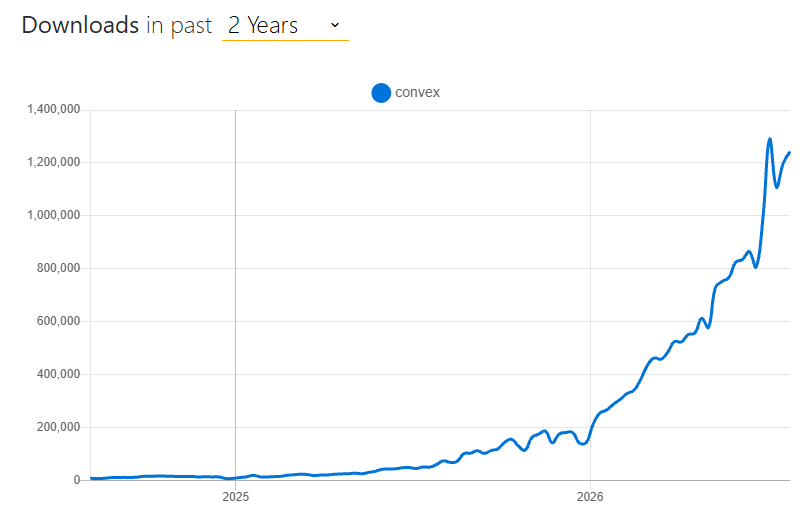
Working with these ambitious customers has given us new clarity about where software is headed, and what our mission is for the next decade. It starts with something we didn't expect.
More agents, fewer sacred cows
Just 18 months ago, we would constantly run into pushback about PostgreSQL with prospective customers. "But Convex isn't Postgres. Isn't Postgres the best database? Doesn't Postgres have subscriptions, too?"
Anything that challenged the status quo was an uphill battle. Developers' loyalty to trusted tools, especially in a high-risk area like databases, made it hard to even get them to try Convex.
Agentic engineering has completely shifted this mindset. Even experienced developers with years of hard-won, platform-specific expertise—the kind who insisted on this database, that web framework, this Linux distro—are now delegating those choices to agents. The human is still responsible for the behavior of the system: the spec, the tests, the interface. But the implementation choices no longer matter, as long as the system works.
In other words, if the evals go up, that's the whole argument. The human doesn't have to learn a new technology, library, or pattern. There's no ramp-up time. When the agent traverses a path with better outcomes, the human reaps the benefit immediately.
The "Postgres objection" has all but disappeared. But in its place, a new anxiety.
LLMs let us generate code faster than any of us imagined. But as these codebases grow, our confidence in their reliability, security, and cost falls. More and more code ships without a human ever reading it, and each change is made with less of the system in view. The nuanced assumptions that held everything together, the ones engineers used to enforce by carefully reading every line, quietly erode. Systems get fragile.
Legacy distributed systems were never designed for this world. Too little of how they actually behave is formalized in code, so they require mindful, skilled engineers to fill all the gaps.
All gas, no breakages.
This is the tradeoff every team now feels: go fast and lose confidence, or slow down and lose the whole point of agentic engineering. With Convex, you don't have to choose.
Convex was built for this world. Transactions are ACID, so concurrent writes never corrupt data. Everything is TypeScript end to end, so a hallucinated field name is a build error, not a production incident. Sync and caching are automatic, so there's no glue code to subtly rot. The guarantees engineers used to enforce by reading every line, the platform enforces instead.
Convex Components take this one step further. Components are sandboxed building blocks, mini backends with their own schema, functions, and data, isolated behind an explicit API. That isolation was always good engineering, but for agents it's essential: a component is a context-window-sized unit of the system. An agent can reason about one component completely, without holding the whole project codebase in view, and it can't reach across the boundary and break an invariant it wasn't aware of. And the reactive database ties these components together, so isolation never comes at the cost of a coherent whole.
Humans and agents thrive on the same thing: systems where correctness is the default. As we abstract away the creation of code, that's the platform the next decade of software gets built on.
“Convex drastically simplified state management for us! We went from localStorage, IndexedDB, context management, and really difficult optimistic updates to a single fast and consistent source of truth. This made it much easier for our team and agents to work on the frontend safely.”
- Raunak Chowdhuri, Founder @ Reducto
The search for the right abstractions
This is a bigger conversation than any one platform, and we're excited to be part of it.
If agents write the code, what's left for humans? We think the answer is: the most important part. Deciding what the building blocks are and what their parameters should be. What problem is actually being solved, and which tradeoffs are acceptable. Call it the architecture of the irreducible: the design decisions that remain after everything automatable has been automated.
Code is cheap now. Design is not. As the price of a line of code approaches zero, the value of good abstractions, clear boundaries, and principled system design only goes up. This is the most fascinating question in software right now, and we think of the Convex platform itself as one hypothesis, a running experiment in what the right building blocks are.
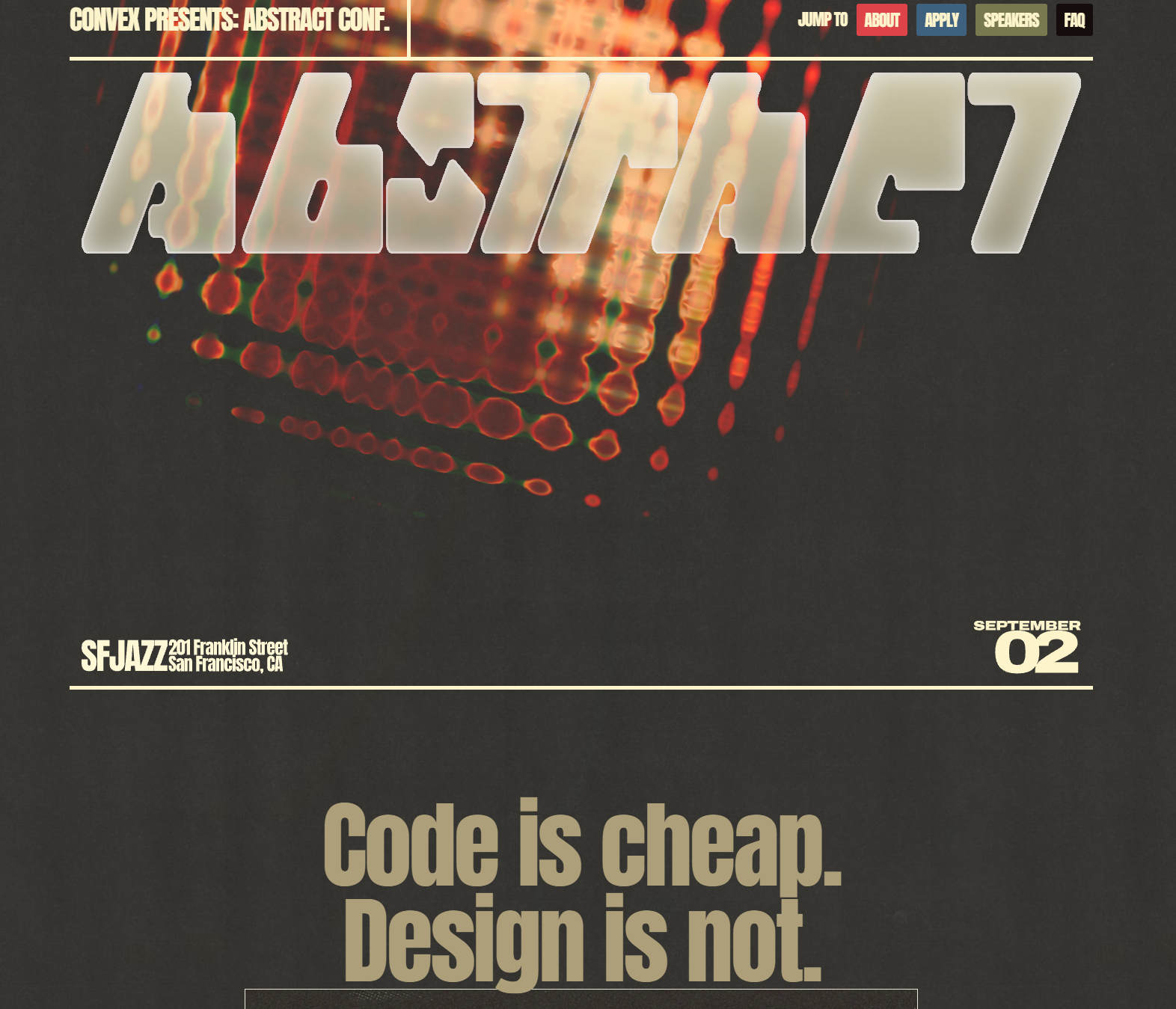
We care enough about this conversation that we're throwing a whole conference around it. Abstract is a one-day event on September 2nd at SFJAZZ Center in San Francisco, bringing together engineers, founders, and designers to talk about craft, simplicity, and the role of the human in this new, more abstracted world. No sponsored talks, no sales pitches. Attendance is free; apply if you're interested!
Come build it
The customers who grasp this model are really excited about it. They want to run agentic workloads at massive scale. They want more capabilities that work out of the box, integrated into Convex's reactive state graph. Every conversation ends the same way: when can we have more?
Here's what we know at this point: Convex is a great idea and a pretty good implementation. This round is about closing the gap between those two, building the platform to the standard the idea deserves, and to the scale our customers are already asking for. A great substrate makes futures possible that nobody planned for, and we want to find out what those are.
So: come build it with us. We're hiring across engineering, engineering leadership, product, marketing, and go-to-market. If any of this post resonated, we'd love to talk. See open roles →